
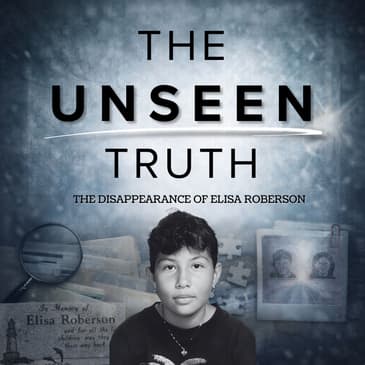
Visit unseentruthpodcast.com for more case information
To learn more about the advocacy work behind this production visit:
https://www.thereignitedproject.com/
If you have any information about Elisa Roberson's case contact:
Aransas Pass Police Department
361-758-5224
Connect with The Unseen Truth on social media:
Follow Us On Instagram
Follow Us On Facebook
It's August sixth, nineteen eighty nine. It's a warm Sunday evening in the small coastal town of Aransas Pass, Texas. The sun is slowly lowering toward the horizon, casting long shadows across the quiet neighborhood streets. The kind of neighborhood where kids ride their bikes until the street lights come on, where neighbors wave from their front porches, and where a short walk down the street doesn't feel dangerous. On this particular evening, thirteen year old Elisa Roberson steps out of her home. She's wearing a light blue Mickey Mouse t shirt, dark blue shorts, and a pair of sneakers. She tells her family she's heading out to meet a friend. The destination isn't far, just a few blocks away, near a local elementary school where neighborhood kids often gather. It's the kind of short walk that happens every single day in communities like this, a quick trip to see a friend. Nothing unusual, nothing alarming, nothing that would make anyone think twice. But somewhere along that short walk, something happened, something that would leave a family searching for answers for more than three decades because Alisa Roberson never made it to meet her friend and she never came home. There are a lot of cases that I come across while researching and investigating stories for this podcast, cases involving missing people, unsolved murders, families who have spent years, sometimes decades, searching for answers. Some of those cases stick with me more than others, not just because of the circumstances surrounding the crime, but because of the people at the center of the story, the families, the lives that were interrupted, and the questions that have never been answered. Alisa Roberson's story is one of those cases. It's a case that I first came across after seeing her missing person's fire circulating online. If you spend enough time in the advocacy in true crime space, you see a lot of these flyers, faces of people who disappeared, dates, locations, a few short details about what happened. But every once in a while, a case grabs hold of you in a way that you can't ignore. For me, Alisa's case was one of those. The first thing that struck me was her age. Alisa was only thirteen years old when she disappeared, and as a mother of four children myself. That number immediately hit close to home because I also have a thirteen year old. When you hear that age, you don't just hear a number. You picture your own child, their friends, their school, their routines, you picture their future, and then you imagine all of that suddenly stopping. No explanation, no answers, just gone. The second thing that stood out to me was how long Alisa has been missing. She disappeared in nineteen eighty nine. I was born in nineteen eighty seven, which means Elisa has been missing for near my entire life. More than three decades have passed since the night she walked out of her home and vanished, and yet her family is still searching for answers, still hoping, still waiting. Eventually, I had the opportunity to connect with Alisa's sister, Ruby, and hearing Ruby speak about her sister, about the decades of unanswered questions, and about the pain of not knowing what happened that night, made it very clear that Alisa's story is one that deserves to be told. Not because I believe a podcast alone can solve a case, but because awareness matters. Because sometimes the right person hears the right story at the right time, and because families like Elisa's deserve to know that their loved one has never been forgotten. I'm Jen Rivera, and this is the Unseen Truth. This season, we're diving into the disappearance of thirteen year old Alisa Roberson. Investigations are a lot like working on a puzzle, and if you've been listening to previous seasons of The Unseen Truth, then you already know. This is an analogy I come back to often because the truth is, this is exactly what these cases feel like, trying to take hundreds of scattered pieces and somehow make them fit together into a complete picture. If you've ever sat down at a table with a brand new jigsaw puzzle, you know exactly what I'm talking about. At first, it's chaos, hundreds of pieces scattered across the table. Some pieces stand out immediately, bright colors, unique shapes, you know exactly where they belong. But others look like they should fit somewhere, but you're not quite sure where. Sometimes you think you've found the exact piece you've been searching for. The colors match, the shape looks right, it feels like it should fit perfectly. But when you try to place it. It doesn't. It's close, but not quite right. And in investigations, evidence works the same way. Witness statements, timelines, tips, pieces of information that seem like they might complete the picture, but until every piece fits, the truth remains incomplete. The disappearance of Alisa Roberson is one of those puzzles, a puzzle investigators have been trying to solve for more than thirty years, and while some pieces are clear, others are still missing. To understand A. Lisa's story, we have to start with the place where she lived. Aransas Pass, Texas a small coastal town along the Gulf of Mexico. It's the kind of community where life revolves around the water. Shrimp boats line the harbor, fishing docks stretch out into the bay, and many families have spent generations making their living from the sea. In towns like this, people know each other, kids grow up together, Neighbors look out for one another. It's the kind of place where children walk to visit friends, ride bikes around the neighborhood, and spend summer evenings outside until the sun disappears below the horizon. For thirteen year old A Lisa Roberson, this was home. In the late nineteen eighties, Aransas Pass was a place where life moved at a slower pace. Children walk to school, neighbors knew which kids belong to which families, and on warm summer evenings, it wasn't unusual to see people outside watering their lawns, working on cars and their driveways, were sitting on front porches watching the sun slowly disappear over the bay. For many families who lived here, the town felt safe, not perfect, but familiar, and familiarity often creates a sense of comfort, a belief that serious crime happens somewhere else, somewhere bigger. Some are far away, but cases like Alsa Roberson's remind us that tragedy doesn't always happen in the places we expect. Sometimes it happens in the neighborhoods that feel the safest. Before we go any further into the investigation, before we start looking at timelines, witness statements, and theories, it's important to talk about Elisa herself, because Elisa Roberson is more than a missing person's poster. She was a daughter, a sister, a friend, a thirteen year old girl who had her entire life out of her. So Elisa was the oldest of a siblings. She was the oldest, she was a little more mature. Granted, she was still just a one year older than me, but she just seemed a lot more older because of the responsibilities she had. Alisa's full name was Blanca Elisa Roberson, but to her family and friends, she was simply known as Elisa. She grew up in Ransa's Pass with her parents and siblings, in a close knit household where family meant everything. Like many kids growing up in small coastal towns, Alisa spent a lot of time outside, walking around the neighborhood, spending time with friends, meeting up at local spots where kids in the community would gather. Her world was small in the way childhood worlds often are home, school, friends, family, and the places in between. For Elisa, those places felt safe because this was the town she had always known. Alisa's father worked as a shrimper in the Gulf of Mexico. That meant long hours out on the water and days away from home at a time time. Shrimping is demanding work. It's unpredictable, the hours are long, and the conditions can be difficult. But for many families along the Texas Coast. It's a way of life that stretches back generations. When Alisa's father was out working in the Gulf, the rest of the family cup life, moving at home, school meals, daily routines, the normal rhythm of family life. My mom only spoke Spanish, and Elisa because she only spoke Spanish, but she was also learning English. Alisa just learned English and was able to help my mom with a lot of things. And so when my mom needed to go to doctor appointments, whatever it was, offices where she needed someone to speak for her, it was Alisa that was translating for her, this little little girl, And so that's why I think she had a lot more maturity because she was responsible to help my mom, and she also helped with us little siblings. She was like the second in command. She knew how to keep us under control if we were acting up. And she was just a year and a half older than me, but all she needed to do was tell me, you know, basically knock it off and give me like a little get off, and it just worked. And like many siblings growing up together, Alisa and her sister Ruby shared a bond that only sisters can understand. They grew up side by side, sharing the everyday moments that make up childhood, the kind of moments that seemed ordinary at the time but later become the memories families hold on to the most. Her and I were very close. We were just a year and a half apart, and so she was held back a year. So we were in the same grade. So a lot of our friends kind of overlapped, and some of her friends were my friends. And where she would go, I would tag along and they would kind of be my friends. And at the time I was still the young Braddy's sister, but my mom. She put a lot of responsibility on her too. Hey, you know, if you're walking, you walk together, and if you're going here, you walk together. And we alwaysknew to stick together. So Alisa she would always make sure that we were okay, whether we were walking at so and so's house and she's dropping me off and she's going to her friend's house. She was starting to have her her friends, where these are my friends and then these are my friends now because she's she's becoming a teenager and you kind of want to have your own autonomy. And she was a true gen xer. It's just the best way that I could put it, because it was all the butt rock music from those times, you know, bon Jovi, Motley crue Leada Ford. She loved those bands. We just and we loved MTV. We would just every day after school, That's all we did, was watched MTV and she babysat and she was able to make some money and buy one of her little boom box and she'd buy her tapes, and back before Google, we would have to sit and listen to the tape because we wanted to know the lyrics and be able to sing along. So we would just sit over and over again, take turns between us, and write down all the lyrics to the songs, and so we had so much fun. And then it was during that time too. I know that friendship bracelets were really really big at that time, and we were both into the friendship bracelets. We were constantly break making bracelets, bracelets for our friends. We had them all. In fact, Oh, I'll sometimes have so many bracelets on my hand. My husband says, why do you have so many bracelets? And I just think it's going back to the time where we would you had all those friendship bracelets just on your hand and I have to take some off sometimes and I'm like, oh gosh, it's just going back to when we were thirteen, twelve and thirteen, and so it was a fun time. And we used to ride our bikes. You don't even remember being indoors a lot in the summertime. We were always out. We were always at our friends' houses. And if it wasn't her and I together over here, then she'd go here, we'd go there. But we were riding our bikes together. And my little brothers too, they Alex and Tony kind of they were their own little group and they'd go do their things together. But Alisa and I would walk to school together, we'd get on the bus together, you name it. And so that summer I think was the first summer where she was kind of starting to be her own. You know, I have my friends, you have your friends, and I'm sure I was getting to be annoying. I'm sure, you know, because I just wanted to hang out with her. Yeah, So I just remember all those fun times, and that's what I when you ask about her. That's why I laughed so much, because we were always laughing and having a good time. Friends and family remember Elisa as someone who enjoyed being around people, the kind of teenager who spent time with friends in the neighborhood, walking between houses, meeting up in the places where kids in the community often gathered. At thirteen years old, life was still unfolding in front of her school friendships, the excitement of growing up, all of the possibilities that come with being young. But for Lisa's family, those possibilities were taken away in an instant, and the image they carry of her today is still the same one from that summer evening in nineteen eighty nine. For Ruby, those memories of Elisa are frozen in time because Alisa never had the chance to grow up. She never had the chance to graduate high school, start a career, build a life of her own, and her family's memories Elisa is forever thirteen years old. For families of missing children, time doesn't behave the way it does for everyone else. Years pass, birthdays come and go. Life continues moving forward, but the questions remain exactly where they started, What happened, where are they? And will we ever know the truth. For the Roberson family, those questions have followed them for more than thirty years. When someone disappears at such a young age, time does something strange. For everyone else, life keeps moving forward. Years pass, families grow older, children become adults, but for the person who vanished, time stands still. For Lisa's family, the image they carry in their minds is the same one from nineteen eighty nine. A thirteen year old girl with dark hair and bright eyes, A girl wearing a Mickey Mouse t shirt on a warm summer evening. A girl who was supposed to walk a few blocks to meet a friend and return home shortly after, but that moment never came. More than thirty years past, decades of birthdays, holidays, family milestones, all of them are marked by the same question. What happened to Alisa Roberson? Sunday, August sixth, nineteen eighty nine started out like a normal day in Aransa's pass. There was nothing unusual about that day, nothing that suggested anything out of the ordinary was about to happen for Elisa and her family. It was simply another summer evening. Earlier that weekend, Alisa had spent the night with a friend, a normal sleepover between teens, the kind of thing families hardly think twice about the next day unfolded like many summer sundays in Ramsa's pass friends, phone calls, plans being made, nothing that would suggest the day would end the way it did. Later that evening, Alisa returned home, and shortly after she arrived, the phone rang A friend was calling to ask if she could come over. That simple phone call would set the events of the night into motion, the kind of evening where kids go outside, where neighbors sit on their porches, and where the day slowly fades intonight. At some point that evening, Alisa told her family she was going to meet a friend a short walk just minutes from her home, a walk she had likely made before. To anyone watching from a nearby window or passing by in the street, there would have been nothing unusual about the scene, just another teenager walking down the street heading to meet a friend. But somewhere between Elisa's home and the place she was supposed to meet her friend, something happened, something that no one saw, something that no one reported, something that would leave a thirteen year old girl missing without a trace. At first, there was no reason to panic when a teenager says they're going to meet a friend. It's not unusual for them to be gone for a little while. Maybe they stopped to talk, maybe they ran into someone else along the way, maybe they decided to walk somewhere else for a few minutes. But as more time passed, something began to feel wrong. Alisa never arrived at the place she was supposed to meet her friend, and when she didn't come back home, her family knew something wasn't right. What started as a normal evening quickly turned into something else entirely concern, confusion, fear, the realization that Alisa had vanished somewhere along that short walk, and the hours and days that followed, Elisa's family searched desperately for answers. Neighbors were questioned, search efforts began. But the truth is no one knew what had happened. A thirteen year old girl had disappeared within just a few blocks of her home, and no one saw a thing. No witnesses, no clear explanation, just questions and a puzzle that investigators have been trying to solve ever since. Next time, on the Unseen Truth, we take a closer look at Alisa's final walk, the route she took, the timeline investigators believe unfolded that night and the moment her disappearance was first reported, because somewhere along that short path is the answer to what happened to Alisa Roberson. The Unseen Truth is a Reignited Media production, hosted, edited, and produced by me John Rivera. A special thank you to Reignited Media's own Sam Cole and Rote George for their support in scheduling and conducting the interviews that made the season possible.