
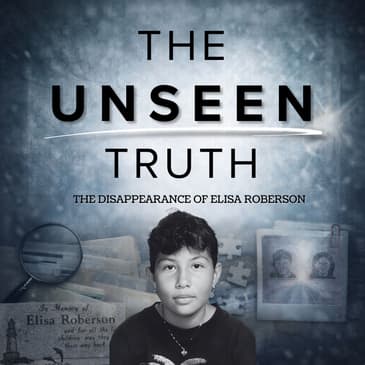
No clear direction. No explanation. No resolution.
Just a missing 13-year-old girl…and a trail that ended without warning. When something like that happens…the silence doesn’t stay empty for long, because people don’t sit comfortably in not knowing. They start asking questions and slowly those questions turn into something else. Because when there are no answers…people begin trying to create them and that’s how rumors begin...
Visit unseentruthpodcast.com for more case information
To learn more about the advocacy work behind this production visit:
https://www.thereignitedproject.com/
If you have any information about Elisa Roberson's case contact:
Aransas Pass Police Department
361-758-5224
Connect with The Unseen Truth on social media:
Follow Us On Instagram
Follow Us On Facebook
The search didn't give them answers. The dogs followed Elisa's trail, the helicopters scanned from above. The community showed up in numbers no one expected, and still nothing, no clear direction, no explanation, no resolution, just a missing thirteen year old girl and a trail that ended without warning. And when something like that happens, the silence doesn't stay empty for long because people don't sit comfortably and not knowing. They start asking questions, They start replaying moments, they start looking at things differently, and slowly those questions turn into something else, conversations, speculation, names, because when there are no answers, people begin trying to create them, and that's how rumors begin. In the days immediately following Elisa's disappearance, the focus was still clear. Search efforts were ongoing, investigators were retracing steps. People were still hoping she would be found nearby safely. But as the days passed and nothing changed, something else began to take shape. The conversations shifted. They moved away from where could she be and toward what do we think happened? And that's a very different question, because once people start trying to answer that, they're no longer working with facts, they're working with interpretation. Before we move into what people believed, we have to go back to what actually happened, because the last confirmed moments of Elisa's life don't match what the rumors would later suggest. Jennifer Taylor, who saw Lisa that day, describes that interaction in her own words. That particular day, I was outside doing some yard work. I was planting flowers in a flower bed, and my house had a sidewalk in front of it. It's one of the few houses in Randa's paths that have a sidewalk in front of it. And she was walking down the sidewalk and I stopped her, said hi to her, talked to her for just a minute or two, asked her to stay and hang out, and she said that she couldn't because she was on her way to go meet a friend. And what stands out about that moment is how normal it was. There was no urgency, no fear, an indication that anything was wrong, just a young girl walking through her neighborhood. And that contrast between what was seen and what was later believed is what makes this part of the case so complicated. Rumors don't just appear They're built slowly at first, then all at once. They come from pieces of truth mixed with uncertainty, from things people heard but didn't fully understand, from details that felt important but didn't have context. And in a small town like Ranza's Pass, those pieces don't stay contained. They move from one person to another, from one version to the next, and with every retelling they shift slightly until eventually they become something else, entirely, something that feels like truth even when it isn't. In cases like this, there's a pattern when there are no clear answers, people start close. They look at the home, the family, the people who were there every day day, because it feels like the most logical place to begin, and in Elisa's case, that's exactly what happened. Questions started forming about what life was like inside the house, what people didn't see, what might have been happening behind closed doors, And those questions didn't stay questions for long. They turned into assumptions and eventually into accusations. But this is where we have to stop for a second and listen to someone who actually lived inside that home, because speculation about a family is very different from reality. Ruby shares what life was actually like growing up and what was happening inside that house that most people never saw. So Ralph came into the picture. I was about five years old, so Alisa would have been about about six. That's about my first memories of Ralph. I was about that age in kindergarten and she had so my parents were separated and head went to prison, and so my mom him and so she was alone. She met Ralph and and she's she talked about I mean like, I didn't know him when he was nice. I only the only really memories that stand out is when he was you know, mean, And so she said that he wasn't he wasn't like that at the beginning. You know, of course, he's you know, putting on his best, you know, best face, his best side, and so she thought he was a nice guy. And the funny thing about it is he was actually protecting her because there was some guy that was bothering her, that kept following her, and he had to from how I remember the stories, he basically told the guy to, you know, go away, leave her alone. And so she thought, oh, he's a nice guy. And and then and then I guess as time went on, he just he just became really abusive towards my mom physically, and and very abusive towards us kids, and and so you know, he was he was not a He was not a good person at all. And he I do remember there would be times where he would laugh and he would be nice, and it would be so confusing to me because I would think, wait a minute, why is the acting so nice, Like he's really mean, and and it would just mess with my head. I'm like, and so we didn't like him, and it wasn't a type of relationship where he was always at our house. He would come and go a lot because of the type of work he was doing. He was a he was a drug mule and so he it was involved in some some really bad stuff and the drug trade. It's right there on the border, and so he he wouldn't he would go, he would be gone. He did some work as a shrimper also, but he would come and go. We never knew when he was coming or going. It could be weeks and I don't know, as you know that in my head, it just seemed like sometimes he'd be gone for a while and then then he'd be back. He'd be back for a couple of days, sometimes a week, and then he'd be gone again. And we always knew when he came back it was gonna our lives were going to be hell. You know, every time he came back, he was just gonna make our lives hell. And I think he really enjoyed almost like a say this, like he really enjoyed seeing us in pain and in fear, and he would just do some really awful things. So there was a lot of psychological abuse, trying to keep us afraid, you know, making us kneel for hours on end on rice on a hardwood floor, you know, that type of punishment. Yeah, and and Tony got the worse of it because of his disabilities. It was harder for Tony, and so he was he was meaner to Tony, and the things that he would do to him were just really cruel. And when my mom would try to step in and say, you know, don't don't hurt my children, or don't hurt my son or my daughter whoever he was targeting at that time, of course, then she would get the beating and and then we tried, you know, it was just it was just so bad, and there was a lot of fighting and a lot of you know, him beating her. We saw a lot of beatings. We you know, Tony was always the one, you know, running to the police. If if my mom was hurt and he couldn't get to the phone, he would he would jump out the window and run to the police station. And lucky we we lived close to the police station, so so the police were always coming to our house. When when my mom was was being beat he broke my mom's arm, he choked her, he beat her, I mean, you name it. We saw so much stuff as little children. Yeah, no, no child should ever have to go through that, and nobody should ever be you know, have to experience that kind of violence from their partners. So yeah, so my mom tried for a long time and it was just this vicious cycle and he would leave and then she'd think, Okay, maybe he's gone, he won't come back, and then he'd come back again, and it just and then she had my little brother, Alex, who was Ralph's son, and and then that just seemed to you know, hook them. You know now that he has a son. So it was it was hard and in those days you don't talk about it. It's a shameful thing. And your friends know. Everybody knows, but nobody wants to report it to the police. Her friends would witness the beatings, they would happen right in front of them, and nobody would call the police. It'd be afraid. But Ralph was that dangerous of a person that he would say and he threatened my mom. He said if he threatened her friends, that if any of them called the police, he would burn their houses down with them and their children in the house. So that's how he was. He was a horrible, horrible, evil person. And and so people were afraid, and even people that knew my mom said, what are you doing with these people? Like? They're dangerous? And if they know I'm helping you, they're gonna kill me. They're gonna kill my family. So these were very dangerous people. And I don't know how my mom. I really don't know how my mom came out of that alive. I really don't, because towards the end, he was telling her that his friends were afraid of her and were encouraging him to and and saying they should kill her because she's a threat to them. Because she knew a lot, She knew of a lot of what was going on in terms of the drugs and the interactions with people she knew, and she was a threat to them. So towards the end, there were there were a lot of threats of them killing her. And he would tell my mom, we could, we could kill you and make you disappear and nobody would ever find you, and nobody would care. You would tell her, nobody would care to come looking for you. You have no one here, you have no family, nobody, nobody would care. And he would be with us. Little kids would be in the car. Well, he's telling my mom this and forcing her to get out of the car, and we're under a bridge and there's water, and he's saying he could drown her and murder her right here, and nobody would It was. It was, I'm telling you it was. Sometimes when I say these things, I cannot even believe that these things happened to us. That's because of how horrible they are that it's it's hard for me to even hear. But my my mom was terrified of him, and towards the end, I don't know how she was able to make him go away, but he had made sure to threaten her, and he told her that he was going to make her feel the same because she wouldn't let him see his son. And he says, I'm going to do something to you where you're you're never going to be rid of me. I'm going to do something to you that you're always going to remember me. You'll never be rid of me, is what he was throwing. I'll do something to you that will make you always remember me. And so because you're taking my son away, I'm going to almost like a threat. You're you're trying to take my son away, you know. And then shortly after that was when when Alisa disappeared. There were other times when one time that my mom said, there was a news story about a missing woman or a murdered woman, either missing or a murdered woman, and that he was very interested in this story. He turned up the TV he wanted to hear. He told everyone to be quiet, and she said, when the news story was done, he left the room and he went to the bathroom and shaved his mustache. And so she said, at that moment she knew, she knew that he had something to do with this woman's either her disappearance or death. And she said she just that's when she just had chills, just went up and down her spine, and she knew at that time that this is very serious and that she could she might not come out of this alive. What Ruby describes isn't subtle. It's not something that needs interpretation. It's direct, it's detailed, and it changes the way this case should be understood because instead a vague suspicion, we now have lived experience. But what makes this even more complicated is how that information was handled. Ruby explains that when she spoke to investigators, they weren't always listening in the way she needed them to. They were asking a lot of questions, but one of the questions I felt they kept trying to get me to talk about or to say that my mom was abusing us. It's like they were trying to get me to to say something that wasn't true, that didn't happen. They were asking me the same question in different ways, asking if my mom beat us, asking if my mom abused us, asking if I if she hit a Lisa, asking if they had a fight. I mean, it just was over and over again, and I just felt like how many times do I have to keep answering this question? And then growing up in the in the eighties. You know, we're gen xers, we're raised by a different generation. You know, these days they see things as abused, But in those days, this is how kids were disciplined. You know, our parents were tough. My mom was a single mom. There was no she had to be tough. There was no ifans or butts about it. She had to be tough. So she was tough with us kids in terms of discipline. You know, if we needed to have we needed to be whooped, if we needed to be spanked, you know, it had to happen. So and I was trying to explain this to them, Well, yeah, you know, we were This was a time and a place that this was a common kids were spanked. Kids were you know, you get a switch and they get a whack behind, you know whatever. And I'm trying to explain this, and I'm trying to say this without making it sound like we were being you know, be by my mom. And I was trying to explain to them that yes, there were things happening in our home, but the person that was inflicting this, this the most damage to us, that was abusing us was was Ralph. You know, my mom's boyfriend, And so I kept telling that, and it just felt like I was going in circles. And then after I went, my mom then went and talked. They interviewed her too. It seemed like a long time, and my mom said, they asked me questions about Bob Green, they asked me questions about Ralph Gonzalez. But at the end I realized they weren't interested in Bob. They weren't interested in Ralph. They were interested in me. They were looking at me that I had. They were trying to get me again. They were trying to get my mom to confess to a crime she didn't commit. They were trying to get her to say that she had heard a Lisa. Instead of focusing on what Ruby was saying, the direction of the questioning was shifting somewhere else, toward a different narrative, one that may have seemed more familiar but didn't reflect what was actually happening. Richard Norgard is the Roberson family's private investigator. He discusses why Ralph remain such a significant figure in this. Case from testimony of various witness is that he was a dangerous man capable of inflicting harm on others he was. We know that he was a drug dealer in the Rensis Past area. There is some evidence that we've turned up indicating that he may have was in fact known to the police. My thought is that he should have been sort of the prime suspect to begin with. In the conversations I've had with folks over the years, I'm not sure that he was sufficiently focused on you know, again, I was trying to I'm trying to dispel this notion that he should have been dismissed as a suspect just because he was in prison. And again, I'm not convinced he was in prison on August sixth, But whether he wasn't or was not, I don't think that in itself should exclude him as a suspect. For the reasons that I've stated, I think he could have, Like I say, I think it would have been his style to in fact find another way to hurt your mother without directly involving himself. What makes Ralph stand out is not just proximity, its behavior, its history. It's the combination of instability, control, and violence that investigators couldn't ignore. And when you look at those factors together, it becomes clear why his name continued to surface, but Ralph wasn't the only name being discussed. Another theory began to take shape, one that pointed towards somewhere else entirely toward Bob Green. Elisa's friend, Debbie's father, someone who was connected to the family, someone who was part of the environment a Lisa moved through. And in cases like this, proximity creates suspicion because when there's no clear suspect, people look at who was close, who had access, and who had opportunity. Very early on into the investigation and with Linda, they both focused in on Bob Green because they knew the history. They knew of the deviant behavior, they knew of the instances were DeBie, that it had been reported and the abuse had been reported of things that he was doing to other children, and so she knew the history. They knew the history, and that's why they kind of they knew things that we weren't aware of at that time, why they were so focused on Bob Green, And still to this day still still feel that Bob is responsible and that he knows what happened. And the funny thing is is that here we are spending so much time on this other theory about my mom being involved, that he just keeps getting older and older, and he's almost one hundred years old, and the likelihood of us ever getting anything out of him at this point is probably gone because he'll be he'll be dead soon. So that's what's so frustrating about this whole thing. I do know they went to talk to Bob in around twenty ten, and that they they were still it was another police chief at the time and another the Texas ranger, Tony Deluna. They had went and talked to him, And this is what I've been able to gather from the other people I've interviewed, is that they did go talk to him, and they put pressure on him to try to confess, and that he turned it back and says, well, you need to look at Marina. She's the one who did something to Ruby or to Elisa, and check her little brother Tony too, and who has you know who had mental health problems and disabilities, my little ten year old brother at the time. And so that's that's the only thing that we can think why it turned on us. And then of course Debbie has just been very vocal of accusing our family and saying that she knows that Alisa was murdered in her home. So and that's Bob's daughter. So, you know, one of the motives. The only thing that we can think of is why else would you becoming so hard at our family. The only reason we can think of is to protect your dad or to protect your family name or whatever her motives are. Able. Penya, who is part of Project Absentis, which is a nonprofit that brings together retired FBI agents, law enforcement and intelligence professionals to help families find missing loved ones, worked with the Roberson family. I think that the FBI gave me kind of a strong foundation to work complex investigations. I think it gave me the ability to structure put these cases together and take a look at the like the cases and kind of use an evidence based methodology to take a look at them. And that's kind of the the the angle that we take on a lot of cases that we work. You know, we try to manage these investigations. And just get involved in these investigations. Sometimes these investigations involved like multiple jurisdictions in this case, there could be multiple jurisdictions in this case as well. We're looking at that. I think that the key though, especially with respect to Project of Centus, is just to kind of navigate with the families and with law enforcement. And as I put on the website, we're kind of the bridge. Now. We're not always successful. Sometimes we reach out to law enforcement, you know, with our backgrounds, we're fairly successful and at least finding somebody over there to talk to to work with us. In other cases, you know, we kind of get the you know, the door, the door slam on our faces and we're there. They tell us that, you know, they're not working with anybody. But we've been fairly uh successful. I think the the experiences are helpful. That's kind of shaped the mission project up sentis. I've got a number of uh of really qualified, experienced retired law enforcement that you know, we put our thinking caps on. We discussed the cases periodically in settings like this because not everybody's in South Texas and we're just in different parts of the country and collectively we kind of put our thoughts together and discuss the different cases. That we have. Because rumors can do two things. They can lead investigators towards truth or they can pull them away from it. And in Elisa's case, that line became harder and harder to see, because the more theories that formed, the more complicated the case became. The rumors didn't start with bad intentions, They started with questions, but over time those questions turned into something else, and somewhere within all of it, the truth was still there waiting. Next time, on The Unseen Truth, we follow a lead, a tip that would begin to shift this case in a new direction, because sometimes it only takes one piece of information to change everything. The Unseen Truth is a Reignited Media production, hosted, edited and produced by me John Rivera. A special thank you to Reignited Media's own Sam Cole and Rose George for their support in scheduling and conducting the interviews that made the season gospel