
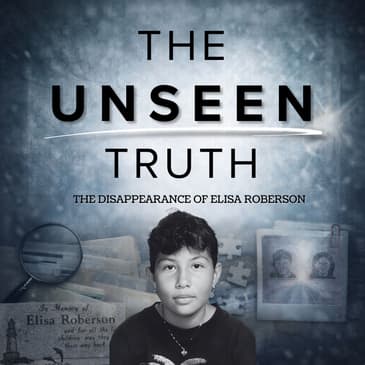
Visit unseentruthpodcast.com for more case information
To learn more about the advocacy work behind this production visit:
https://www.thereignitedproject.com/
If you have any information about Elisa Roberson's case contact:
Aransas Pass Police Department
361-758-5224
Connect with The Unseen Truth on social media:
Follow Us On Instagram
Follow Us On Facebook
There are some stories inside a case that do not show up in the official timeline. They're not marked by a date, they're not captured in a police report. They don't fit neatly into a single event, a single search, or a single theory. But they matter sometimes they matter more than anything else because they explain the people at the center of the story, how they survived, how they responded, how they kept going when everything around them was breaking. And in a Lisa Roberson's case, there is one part of this story that has always been there, even when it wasn't being fully told. Ruby's story, not just Ruby as Alisa's sister, not just Ruby as a witness to the fallout, but Ruby as someone who has been carrying this case for decades while also carrying everything that came before it, the family dynamic, the abuse, the instability, the accusations, the years of being unheard, And if you're going to understand what this case has cost this family and what it has taken for them to keep fighting, then you have to sit with that part of the story too. Because Ruby's fight did not begin in twenty sixteen. It didn't begin when police pushed suspicion back toward the family, and it didn't even begin when a Lisa disappeared. It began long before that. When people hear about a case like Alisa's, they often again with the disappearance, the last day, the last walk, the last confirmed sighting, and of course all that matters. But for the people who lived inside this story, life did not begin with the case. There was a before, a whole life that existed before everything became divided into before Elisa disappeared and after, and that before was not simple, It was not clean, It was not the kind of stable family picture that people often imagine when they first step into a missing person story. From the outside, there was love there, yes, there were memories, there were bonds, and there was also struggle. There was instability, and there were things happening inside that home and around that family that shaped how every single person would later experience Elisa's disappearance. That is why this episode matters, because if the earlier episodes are what happened to Elisa, this episode is about what was happening to the people who were left behind. In Ruby's case, that means going back to childhood, going back to the home, going back to the emotional world she was living in, before any detective, any search team, or any outside theory ever entered the picture. Before you can understand Ruby's fight, you also have to understand Marina. Because Marina's life story is not separate from this case. It's part of the emotional foundation of everything that came after. Marina was born in Nicaragua and grew up in poverty, in instability, and in danger. And her own word, she talks about growing up in a place where safety was never guaranteed, where jobs barely paid enough to survive, and where as a young girl she often felt she had to run for her life and protect herself constantly. She says she did not want Elsa to grow up in that kind of environment, and that one of the things driving her was the desire to get her daughter somewhere safer. That matters because by the time Marina came to the United States, she was not arriving as someone with comfort and secureecurity already behind her. She was arriving as a very young woman with a child with limited English, in a completely different country, trying to survive. And those pressures do not disappear just because geography changes. They follow you, They shape what choices feel possible they shape with dangers you think you can escape and what dangers you think you can endure. Marina talks about meeting Eugene, about him adopting Elisa, and about coming to Texas with hope and excitement, but also about how quickly life became much harder after that. I was born in Sanny Sidro Rio, Sikia, Nicaraua. We lived there. My father was a farmer and my mother was a homemaker. When she stay at home watching the children and when all the housework and we help her. At the age I have ten we will ten seablins all together, five boys and five girls. When I was six years old, my parents moved moved their family to blue Fields. In blue Fields, my daddy got a jab as a shoemaker and my mother went to work for at the Catlic church, teaching as a cook. I went to the Catholic school and when I graduate, I work as a nanny, taken care of the rich ladies children, and I also went to work to the restaurant. People are really poor over there and jobs there are no jobs, and if you find a job, they barely pay anything. So the money that you make while you're work, and that's not enough money to make a living. Danger for a girl. I find myself since I remember running for my life and safety because it was almost like in every corner there was somebody waiting, a man waiting, and you're trying to snatch me, and I have to run and fight. Later on, I met a young man and we were young. The relationship did not lasted, were separate because we were so young, but I end up praying that, and Elisa was born. Then I met your dad. He was working and I say hi, and then I asked him, I mean you're not from here, and he said no, He said, I am from Texas, and I hired by your company, my fishing indose three and I will hire to come and pick up a stream streamper that they have over here. This company was working in the or Wawa. They have a fleet of stream pin boats. And he wanted to meet my family. He wanted to take them to my house to meet my mother and my siblings. My dad was already there, so anyway, so I took your Eugene, your dad, to came home, and he met my mother and all my siblings and met Elisa. She was seven months old at that time. And we spent time together with the family. He was happy. Her dad was supposed to stay there for about two weeks, and at the end of two weeks, he he asked me if I wanted if I will marry him the lie. I told him, well, I have a baby. I said, I'm not leaving the baby behind, and he said, I will enact the baby like if if you will be my own this he said, oh I would. What kind of man do you think I would be? What kind of man would I if I will expect you to leave your baby behind? He said, I will adapt him, but one on my own, and I will take care of her like she would be my own and stop sy We So I accept his proposal and we got married, and then we took Elissa to the courthouse with us, and and he did all the paperwork. For being somebody that do not know anything about Hispanic culture, he did everything right right. Then we got the papers to adapt Lisa. We got married and I was done. It wasn't done, and then he had to live. At the end of two weeks, he left by himself back to Texas. Lisa and I were left behind. But it won't because I did not have a passport. I needed to wait two weeks before I get my passport, I have to go to the American embassy and Manaura. So anyway, at the end of two week, I had my passport and Elissa and I boarded the airplane to Texas. And then your dad was waiting at the Houston airport, and I was so happy to be in the United States. Everything well different. Body was excited and it was like a big adventure. Now this is important because it places Marina not as a background character in the case, but as a human being with her own history of trauma, survival, and vulnerability. And once you understand that, you start to understand why everything that came later hit her so hard. The pain of this case is not just that Alsa disappeared, it's also that she mattered so much inside the family system. Ruby describes Elisa as the oldest, the more mature one, the one who helped Marina translate, the one who was often the bridge between the family and the outside world. Ruby says Alisa was the one who helped her mother with appointments, with language, and with everyday responsibilities far beyond her age. She also describes how close they were as sisters, walking to school together, riding bikes, doing everything together. Their lives almost completely overlapping, and that kind of role changed the emotional stakes because Alisa was not just another sibling in the household. She was, in many ways the glue that held the family together. She helped Marina function in a world she was still trying to navigate. She helped keep the younger siblings in line. She was to Ruby both sister and anchor. So when Alisa disappeared, the family didn't just lose a child. They lost one of the people carrying part of the emotional and practical weight of that family's life. That is why the absence was so massive. That is why everything afterward feels so unstable, because when someone who plays that kind of role disappears, the whole structure around them shifts, and the people left behind have to figure out how to hold things together while they're grieving someone who helped hold them together in the first place. This is where Ruby's story stops being background and becomes central, because the environment she grew up in matters deeply to this case. Ruby describes a childhood shaped not just by power in stress, but by fear. Fear of Ralph, fear of what happened when he was around, fear of how quickly things could turn. Ruby describes Ralph as someone who came into the picture after her parents separated, and she says that while he may have appeared different at first, the version of him she remembers is violent, cruel, and psychologically abusive. She says he would come and go, often disappearing for stretches of time and then returning, and every time he came back it felt like life inside the house was about to become miserable again. Ruby explains that he was physically abusive to Marina and abusive to the children too. She describes him as someone who seemed to enjoy fear and control, someone who was cruel in the way he punished them, including making them kneel for hours on rice and terrorizing them psychologically. She says Tony in particular, got some of the worst of it because of his disabilities, and that when Marina tried to intervene, Ralph would turn on Marina too. This is not a minor detail in this case. This is context because when later theories begin circling around Ralph, or when Marina keeps insisting that she believed Ralph took Alisa. Those beliefs are not coming out of nowhere. They're coming from years of lived fear, years of violence, years of witnessing what he was capable of and what he threatened. Ruby talks about that home environment and stark, painful detail. There was a lot of fighting and a lot of you know, him beating her. We saw a lot of beatings. We you know, Tony was always the one, you know, running to the police. If my mom was hurt and he couldn't get to the phone, he would he would jump out the window and run to the police station. And lucky we lived close to the police station, so so the police were always coming to our house. When when my mom was was being beat he broke my mom's arm, he choked her, he beat her, I mean, you name it. We saw so much stuff as little children. And then Marina comes in and confirms that from a completely different angle. Marina explains that Ralph had been following her long before he made his move toward her. She says he later told her he had been keeping an eye on her since the time Eugene first brought her to Ransa's pass. She also says he broke her arm while she was pregnant with Alex and threatened to break the other one if she ever told anyone what had happened. She talks about the fear of being killed, of having her babies hurt, and of living inside total control. This was abuse, intimidation. This was a woman trapped in a relationship where every consequence for speaking could feel fatal. Marina explains it in language that is plain and devastating. And nil Ralph since I will live in na Abdi mister Green's duplet Leira Leiro. He told me that he had been follow on me since your dad brought me door r as aspassed. He said, I've been keeping an eye on you. And he followed me in the car. He saw me getting a bag of groceries and with Lisa holding her hand, and he said, I have been following you since then he said, but what he said, but what your husband was here heself, And and then when he find out that that Eugen I didn't know that that he went to prison. Then he made made his move. He broke my arm when I was trained with Alex, I was four months trainer and he broke my my arm. Then took me to the hospital and and He told me that if I ever say anything about it, that he was going to break my other arm. So people people say sometimes, well, Marina, there was there was enough viser over there at the hospital. He was standing there, and they probably suspected something. But I could not say a thing. I could not say nothing because end doubled another broken. Well, that's why he said. And then and then I have the babies, yo all, and I, oh, my gosh. And he threatened me. He threatened me with furling my babies, and he treaded me with breaking my other arm. One of the most painful things in Ruby's interviews is hearing how later investigators seem to misunderstand the family dynamic entirely. Ruby says that daring, questioning investigators kept trying to get her to say that Marina had abused them. She says they asked over and over if Marina had beaten them, if Marina had hit Elisa, if there had been a fight, and Ruby says she kept trying to explain that well, the family had a hard life and discipline was different in the nineteen eighties. The person who was truly inflicting harm in the household was Ralph. That is a huge part of Ruby's fight, not just grief, not just advocacy, but the experience of trying to tell the truth about what her family lived through and not being heard correctly. It's one thing to survive abuse, it's another thing entirely to later sit in front of investigators and realize that they're trying to force your story into a shape that doesn't match what happened. Ruby describes that feeling with a lot of pain. She says they were asking her the same questions over and over again in different ways, trying to get her to say something that wasn't true, that Marina was the abusive one, and she says she kept telling them no, that the abuse, the real fear, the real danger, came from Ralph. A couple of years after Lisa disappeared, he started coming around in the town and my mom started seeing him, and that's when she freaked out and said she needs to get out of that town. We need to get far away because she was afraid he was going to do something to one of her other kids. And so that's when we finally left Texas to Idaho. After Lisa disappeared, Grief entered the home, but it didn't erase the other dangers surrounding them. Marina says that after a Lisa went missing, she was terrified Ralph was still out there and that the rest of her children could be taken too. She describes feeling like she had to keep the family gathered like a mother hen protecting her chicks, because any of them could be snatched. Next. That fear became so overwhelming that when help finally came from a bishop and his wife in Idaho, she took the children and ran, leaving almost everything behind. That's a level of fear that we need to talk about because it shows that the disappearance didn't just create grief. It intensified survival mode. It intensified the belief that the family was still in danger. And when people later judge Marina's behavior, or Ruby's intensity, or the family's desperation, this is part of what they're missing. Marina wasn't just grieving. She believed she was trying to save the rest of her children too. Another thing Ruby speaks about in a way that is incredibly moving is how Marina was perceived after Olsa disappeared. Ruby says Marina got a lot of attention, but not always the kind of attention of grieving mother needed. She talks about how people may have looked at Marina as irrational or crazy, but that until you were in that situation, you cannot know how you would respond. Ruby describes Marina as beside herself, desperate for information, adamant that investigators needed to look at Ralph, and unable to simply sit quietly while her child was missing. That prospective matters because it gives you an interpretation of Marina's urgency, not instability, not suspicion, grief, panic, terror, And anyone who has ever watched a family trying to get answers from institutions that won't communicate clear will recognize that dynamic immediately. Ruby reflects on that. Right, wrong or indifferent, you're never thinking rationally when you know, I don't even want to be in a situation where when it's your child the way I see it, when it's a child, that's a whole other level of I can't even imagine. You know, it was Elisa was my sister, and the pain is so deep, But I think if it were my child, that's a whole other, whole other layer that that that you have to deal with as as a parent, and I think the worst pain is losing a child, and so my mom just wasn't She just was so distraught and so panicked that I think at the time she wasn't using her best judgment. I think she was just lashing out, and she was just trying to get them to listen and to pay attention and say, you know, it was Ralph. So she probably, you know, from the outside looking in, people were probably thinking and she's but thank god that Linda Thompson says she was. She knew that that my mom was a grieving mother and that everything that she was experiencing, you know, it's you can't predict how you would act. I'd go crazy. I'd go crazy if it had been my child, that I'd be angry, I'd be acting irrational, and I'd be doing everything to be heard and to be listened to. And my mom's she got a lot of attention, and it probably wasn't always the best of attention when you know, but I at the time, I can only fathom being in that predicament, being so distraught and not knowing what to do and so panic that that she probably had people just kind of look at her a little. You know, oh she's crazy or something and so, but until you're in that situation, you can't judge what people are going to do or say, or how they're going to react or act. And that's that's what she was saying, she said up to even to this day. She goes, Ruby, Now you see, now you get a taste of what it's like to be constantly shut down and ignored and shut down and ignored, and they won't tell you, and they won't talk to you, and you have to try to figure it out on your own. Now, Ruby makes it very clear and states that she understands that Marina didn't handle everything perfectly, but by insisting that people see her in a certain context as a grieving mother, as a frightened woman, as someone who believed she knew where danger was and couldn't get anyone to listen. Now, Richard can provide additional context here because he helped structure what Ruby and Marina are telling us emotionally. He says that not only Marina, but the children too were made to fear Ralph. He describes him as controlling, violent, and insulting toward women, and he says the threats he made should never have been taken lightly. He also references documentation of prior police calls and the fact that Marina took those threats very seriously. That matters because this isn't just the family saying we were afraid of him. This is someone with investigative experience saying there were real reasons that fear should have been treated seriously. From the perspective of an investigator. It's important to note that the nature of Ralph and the nature of the threat itself, the relationship had been kind of an unusual one in it. It wasn't sort of a normal girlfriend boyfriend relationship. This was a guy who was involved during that whole time in criminal activity, and he was going from place to place, hopping from place to place with no real sort of home base, as it were. He was doing things that he didn't want people to know what he was doing and didn't want to be tracked, and so forth. He was laying low, keep trying to keep under the radar. That sort of describes sort of the lifestyle that he led. It was a volatile relationship in which there was assault of behavior. Not only Marina, but the children were made to fear him and he was abusing them in various ways. This threat that was made was one that certainly should not have been taken lightly. Ruby's fight is not just the fight to keep Elsa's name alive. It's also the fight to have the truth of her family's experience understood, the fight to say, no, this is what the home was actually like. No, this is who we were actually afraid of. No, this is what investigators kept getting wrong. And no, this is what it has cost us to carry this for all these years. That is why Ruby belongs at the center of this season, because she's not just giving commentary on the case, she's giving shape to the emotional truth of it. And part of that truth is that even after all these years, she's still caring not just the pain of losing Elisa, but the burden of trying to correct the story around what happened to her family afterward. Then there's the humiliation of being accused. Marina says plainly that she had absolutely nothing to do with Lisa's disappearance and that the accusations about an affair with Bob Green or helping hide Lisa's body are ridiculous and cruel. She says, they have already gone through the ordeal of losing Lisa, and then on top of that, they had to go through the ordeal of being accused of hurting her. She also says the police never publicly cleared them in a way that corrected those rumors. That is another part of this family's fight, not just grief, but public suspicion layered on top of grief. At this point, it should be clear that Elisa's case has remained alive, not just because it's unsolved, but because the people inside it are still carrying the consequences of it. The disappearance never ended, not emotionally, not psychologically, not socially, not in the way. The family has had to keep fighting, defending themselves, correcting narratives, and try to honor a Lisa while surviving everything else attached to her case. This is what Ruby's fight really is. It's the fight to keep Elisa at the center without letting the truth of her family's experience be erased. It's the fight to say that what happened to Alisa matters, yes, but so does what happen to the people who are left behind. Ruby's story is not a side note in a Lisa Roberson's case. It's a part of the case. It explains the fear, the pressure, the urgency, the grief, and the years of fighting to be heard while carrying things most people will never fully understand. This isn't just the story of a missing sister. It's the story of what it takes to survive what comes after. Next time, on The Unseen Truth, we take a closer look at the investigation itself, the decisions that were made, the direction the case took, and the moments where everything could have gone differently. Because once you step back and look at the full picture, you start to see how this case was shaped in real time and how those decisions are still impacting it today. The Unseen Truth is a Reignited Media production, hosted, edited, and produced by me John Rivera. A special thank you to Reignited Media's own Sam Cole and Rose George for their support in scheduling and conducting the interviews that made this season possible.