
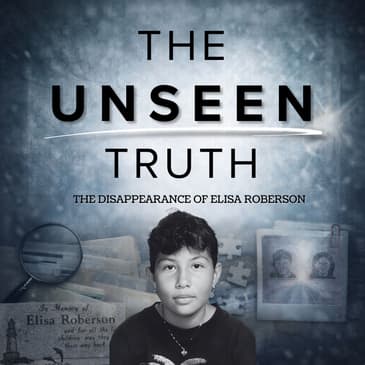
Visit unseentruthpodcast.com for more case information
To learn more about the advocacy work behind this production visit:
https://www.thereignitedproject.com/
If you have any information about Elisa Roberson's case contact:
Aransas Pass Police Department
361-758-5224
Connect with The Unseen Truth on social media:
Follow Us On Instagram
Follow Us On Facebook
There is no clean ending to a story like this, no point where everything ties together, no moment where the questions stop and the pain makes sense. Because Alisa Roberson's story didn't end in nineteen eighty nine. It changed in nineteen eighty nine. That was the year everything broke open, the year her family's life split into two parts before she disappeared and after, and everything that has happened since then, all of it, the searches, the theories, the interviews, the leads, the years of waiting, the moments where the case felt close and the moments where it felt impossibly far away, all of it has led to one hard truth. Elisa is still missing, her family is still waiting, and after thirty seven years, there's still living inside a question that has never been answered. Where is Elisa? What happened to her? And how do you keep going when the world expects time to soften something that has never actually been resolved. Because time doesn't close a wound like this, It doesn't explain it, it doesn't make it fair. It just makes the waiting longer. And that is the place the story leaves us, not at an ending, but at the reality this family has had to live with for nearly four decades, a reality where love didn't stop, grief didn't stop, and the fight to bring a Lisa home didn't stop either. Thirty seven years is a long time. It's long enough for whole lives to change, long enough for children to become adults, long enough for neighborhoods to change, for names in a police department to change, for headlines to fade and be replaced by other headlines, for people outside the case to start describing it as old. But for a family, that number feels different because thirty seven years is not just time passing. It's birthdays without her, holidays without her, family gatherings where someone is always missing even when everyone else is in the room. It's memory carrying more weight with every passing year, because memory is the only place Elisa is guaranteed to be, and that kind of absence doesn't become easier just because it becomes familiar. If anything, it becomes more layered or complicated, because as the years pass, the family's not just mourning the girl they lost in ten eighty nine. They're also mourning the woman she never got to become, the life she never got to live, the futures that never happened, the answers that never came. And that's the kind of grief that does not move in a straight line. It doesn't rise and fall neatly, It doesn't resolve. It follows you into every year, into every season, into every moment where you look up and realize that more time has passed and you're still standing in the same terrible place, asking the same question. Ruby speaks about that kind of grief in a way that is deeply personal and painfully clear. And the highs are highs and the lows are lows, but you just keep one step at a time, and in a way it makes me feel like there's a purpose to my life. You know, this is the one thing that I have a you know, some people march for domestic violence and against domestic violence, or for children being abuse or cancer or you know whatever it is, sex trafficking, missing children, and everyone's got their thing that they fight for that they have to fight for. And for me, it's a Lisa, you know, I have to She's She's what gives me purpose and gives me this energy and makes me feel alive and makes me feel, you know, like I have something I want to fight for and I you know, it's like the Knight's templar, you know, getting their shield and their their cape and their sword, and it just it gives you this energy like I have a purpose and I have something that I'm fighting for and that means something gives my life meaning and enjoy. What Ruby is describing here isn't just activism. It's survival because after a loss like this, people have to find some way to keep living inside a story that never ended. Some people shut down, some people go quiet, some people cannot bear to keep opening the wound again and again. But Ruby found something else, a fight, a purpose, a reason to keep going when it would have been easier, in some ways to stop expecting the world to care. And that matters because the season has never really just been about the mechanics of an investigation. It's also been about what it takes to carry an unsolved case and not let it disappear, not let the victim disappear, not let the years swallow the story whole. Ruby has done that for Alisa, and when she talks about purpose, what you hear underneath is love, a love strong enough to outlast exhaustion, a love strong enough to keep getting back up after disappointment, a love strong enough to keep going even when the odds after thirty seven years are the kind of odds that would make a lot of people lose hope. Most people understand one kind of grief, the kind with a known loss, a funeral, a burial, a place to go, a moment where the unbearable truth is at least visible, at least nameable, at least anchored in something concrete. This is not that kind of grief. This is grief without a body, without a final goodbye, without certainty, without a place to go and say, this is where she is. This is where I can bring flowers, This is where I can sit with her, This is where I can let myself say the things I never got to say. That changes everything, because when there is no ending, grief remains unfinished. It loops, it reopens, it shifts shape, but never disappears. A mother wakes up still not knowing where her daughter is. A sister grows older, still carrying the same empty space she had as a child. Friends move through adulthood, still remembering the last ordinary moments before everything changed, and every year that passes adds not relief but another layer of lost time. This is what makes cases like Elsa's so devastating, not just the mystery, but the not knowing. There is something in Marina's voice when she talks about what was done to her family and what she still needs after all these years. They hoping that that's somebody that knows what happened. Because we know, we know that some people don't know what happened, then maybe they will, They will finally pick up the phone and make that call so that we can put this this case to rest, and give Elisa a proper place to rest, bring her back home, you know, to be again with her family. What Marina is asking for there is not unreasonable, it's not excessive. It's the most basic thing any mother in her position should have had years ago. Truth, transparency, dignity, the chance to know what happened to her daughter, and the chance to stop living in a story where every answer seems so out of reach. It's important to understand that she's not just talking about one event. She's talking about the cumulative weight of decades, the disappearance, the suspicion, the years of not being heard, the ways the case has been handled, the feeling that people with power have been able to move on, while she has had to stay in the same emotional place for nearly four decades. There's no version of motherhood that prepares you for that, no language that makes it easier. There's only endurance, and Marina has endured far more than most people will ever see from the outside. One of the hardest things about long running unsolved cases is how easily the person at the center can be flattened into the mystery a flyer, a file, a name in a database, a case number. But Alisa was not born a case. She was a girl, a thirteen year old girl. She had routines, people, she had family that leaned on her, and ways children should not have to carry, but often do. She helped bridge the gap between home and the outside world. She was the oldest, the more mature one, the one who understood more than people probably realized. And she was loved, deeply loved. That matters because if the season has done anything, it should have done. This brought Elisa back into focus as a person, not just the girl who disappeared, but the daughter who mattered, the sister who mattered, the friend who mattered. Because once you know who she was to the people who loved her, her absence becomes impossible to reduce. Jennifer gives us one of the most human windows into Alisa. Not theory, not evidence, just memory. Alisa would come over and spend Easter with us, have Christmas with us, she went on family vacations with us. So yeah, she was like my little sister that I never had. Now, Jennifer's context here is important because it restores something that time and coverage can take away, warmth life before the disappearance, the sound of someone being remembered, not as a victim first, but as a person, as a friend, as a girl who moved through the world in the casual, ordinary way a thirteen year old girl should have been allowed to. And maybe that's part of why this case still hurts so much, even for people outside the family, because the last day of Elsa's life began like any other day. Nothing about it announced itself as the day everything would break. She was just being a kid, and the world failed to protect her in that ordinary moment. People sometimes think the hardest part of a case like this is the beginning, the first night, the first search, the first awful realization that something is wrong, And yes that is unimaginable, but there is another kind of pain that comes later, the long pain, the drawn out pain, the pain of carrying a case year after year while the rest of the world continues to move. Because families do not get to freeze in time even when their grief does. They still have to work, still have to parent, still have to survive financially and emotionally, still have to endure anniversaries and birthdays and new stories and rumors and silence. Still have to figure out how to build some version of a life while knowing there is a missing piece in the middle of it that cannot be replaced. That is what this case has demanded from Ruby and Marina. Not just grief, but endurance, not just memory but resilience. Not just hope, but the kind of hope that has to survive disappointment over and over again. And that kind of survival deserves to be named. It deserves to be honored, It deserves to be understood as part of the case, not separate from it. One of the reasons the story still carries weight is because people outside the family have refused to let it go too. Linda has been one of those people. I hope that this will open the eyes of new investigators who can look into the case and see what I could have done or should have done, and see if there's anything we can do with modern technology that can answer some of the questions that are still there. That kind of hope matters because it means the family has not been shouting in to avoid all these years. It means there are still people looking at this case and seeing what has not been finished. It means there are still people who understand that just because the case is old doesn't mean it's over. And that matters because hope can start sounding sentimental if it only comes from one place, But here it doesn't. It comes from the family, It comes from friends, It comes from former investigators. It comes from people who still believe the truth has not disappeared just because time has passed. Ruby talks about this in a way that is both heartbreaking and remarkably hopeful. We came to that realization a long time ago that we know she's she's not alive. I mean our hope and this is what gets us excited is all these remains and these Jane does and these these people are being identified. Sometimes twenty thirty, forty forty fifty years, I've seen some really old cases, and these families are finally getting closure, and you're not going to tell me that it means any less. Forty years or fifty years down the road. If you find your loved one, that's that's gonna I mean, it's going to be just as important and exciting. And that's our hope right now, is that somebody's going to find her somewhere. And with all this new resources and money that's going into these these projects to help with missing people or unidentified remains, that's our hope that eventually Alisa's going to be identified. She may not, she may never be found. I have a piece inside of me that I know she's no longer with us. You know that she's she's gone, and I feel her in spirit, and I know, you know she watches over me, and I know sometimes I get these ideas. It's like the craziest thing, like I'm thinking, what should I do for for Lisa's memorial this year, or what should I do for her fiftieth birthday? And it's like an instant second, it's like the idea is there, and I'm like, no way, that is like the awesome, awesome like idea, and that has to be her. It has to be her telling me I want butterflies this year, or I want flowers in the harbor, or I want you know, I want you guys. You know, it's just these ideas that I'm like, where did that come from? I never even thought of that in all these years, never thought to throw flowers in the harbor. And it it was like a second after I thought that, and I'm like it had to be heard. Like there's just no explanation for how some of these things happen. And so I just it's just little things like that, and and I just I just have to go back when I think about her, you know, our our time together and how you know, she was just a big part of my life and my childhood memories. Like I said, just bring so much joy thinking of our little group, you know, me, my brother, my two brothers and Elisa us four. We were like the little rat pack, you know, and so much joy. So when I go back home now I've been able to find now peace in it. And I tell my husband when we go, I know's it's really hard, and it's always just you know, advocating for release and fighting hard. We forget to have joy and so I told my husband when we go down there, and we just we started doing this this last year when we went down, I says, we have to do something fun. I want to show you my hometown where I grew up, but in a in a joyful way. Let's go do something fun. Let's go let's go take a boat ride, let's go fishing or you know, you've never been fishing here, and so that starts to bring back the joy of, like you know, and love for my hometown that has brought so much pain in the past and you know, people turning on us and you know what happened to Elisa and our childhood. But now we have in the last couple of years because of all the advocating, we have so many people who are now supporting us and who are who have our backs and who will do things for us when we're not there, and we'll go to city council meetings for us and speak about Elisa. So we've got followers and it's it's it's fun to say, hey, can you guys do this for me, like I'm not going to be able to make it. Can we do this? And they're like, we got it, And so it's there's so much energy to it, and they're all fighting the same same thing, and they don't know how much their support means to us. That's what's given us the strength to do it, too, is having people who had our backs because we felt so alone for so long. Now this tells you exactly where the family is now. Not in denial, not trapped in fantasy, but in truth, a painful truth, a truth they have had to accept inside themselves without ever being given the dignity of an official answer. They believe a Lisa is gone, they believe she is no longer with us, and still they fight, not because they are confused about what they want, but because they are crystal clear about it. They want to bring Elisa home, They want answers, they want the right to grieve properly. And there's something incredibly powerful about hearing that from Ruby directly, because it strips away all the noise and leaves only what matters. Most Abel Penya has something important to add as well, not empty optimism, but grounded. Never give a pope and also never stop advocating. That's really important because families are, you know, a part of these cases, and they're the only ones that can keep the. Missing person's name alive. They can keep it long after the headline is over. You're keeping her story alive and in the forefront of people. And so it's just really important to keep advocating what able offers. There isn't some polished slogan. It's a recognition of reality. These cases are hard, old cases are harder. But advocacy matters, persistence matters. Keeping someone's name alive matters, And for the family listening to that, it reframes the fight in a way that feels honest, not guaranteed, but meaningful, not easy but necessary. But it also cannot end by surrendering to hopelessness. After all of the years, after all of the theories, after all of the searches and interviews and disappointments and moments that look like they might finally lead somewhere, what this family wants now isn't complicated. They just want answers. They want the truth. They want to bring their Elisa home. That's it. Not a perfect narrative, not a dramatic reveal, not a public spectacle, just the truth about what happened to their daughter, their sister, their friend, and the chance to finally place her somewhere in the world, instead of having to keep carrying her only in memory, Because that is what closure looks like here, not forgetting, not moving on, but knowing, being able to grieve in full, being able to stop living in the half light between hope and dread, being able to say, after all these years, we brought her home. Alisa Roberson is still missing, her case is still open, and her family is still waiting, waiting for ants, waiting for truth, and waiting to bring her home. For thirty seven years, they have lived with a kind of grief most people can't even imagine. Thirty seven years of wondering whether this will be the year someone finally says the thing they have been holding on to. Someone out there knows something, someone still has a piece of this story. And if that person is listening, after all this time, after everything this family has carried, after all the years Lisa has spent missing, please come forward, say her name, tell the truth, because this family has waited long enough, because silence has already taken too much. Because Elisa deserves more than memory alone, She deserves to come home. I know that you know that that she's probably no longer You're knowing the world. She's somewhere. Is her remain where I know that the police say that they know, well she well, we want her here. We want her here so we can we can have a place to go on and put flower bring flowers to her and remember her, you know, the way she was. That's all. That's all we asked for. I miss her. I just I miss her so much, and I I love her, and I love all the memories that we have, that we that we shared, and our short little years that we had together, you know, twelve years for me, but that's that was enough to last my whole lifetime. And I still I feel her love and I feel her presence, and I I wish she could be here. I wish you could be here with I wish my sister. I wish Alisa you could be here with me today, sharing our lives together. You know who would we be. You know, she would have grandchildren and children. You know, we'd be doing barbecues together. You know, our husbands would be you know, best friends. We'd get to go do fun things, family get togethers. You know. It almost feels like when Alisa disappeared, it kind of our family just kind of when we all went our separate ways. At the end of the day, whether we find out what happened to her, the one thing that we would find the most peacing is to have her back with us. And it's been thirty five years. We still want Alisa home and still hope for that, and we just keep praying that we'll find answers. Alisa Robson was thirteen years old when she disappeared in nineteen eighty nine from Moranza's past. When she was last seen, she was wearing a light blue Mickey Mouse shirt, dark blue shorts and sneakers. If you know anything, no matter how small it may seem, this family needs you to come forward. Please contact the Aransas Pass Police Department at three sixty one seven five eight five two two four, Because after thirty seven years, this is not just an old case. This is a daughter, a sister, a friend, a life interrupted, a family still waiting, and if you know something, say something. The Unseen Truth is a Reignited Media production, hosted, edited and produced by me John Rivera a special thank you to Reignited Media's own Sam Cole and Rose George for their support in scheduling and conducting the interviews that made the season possible